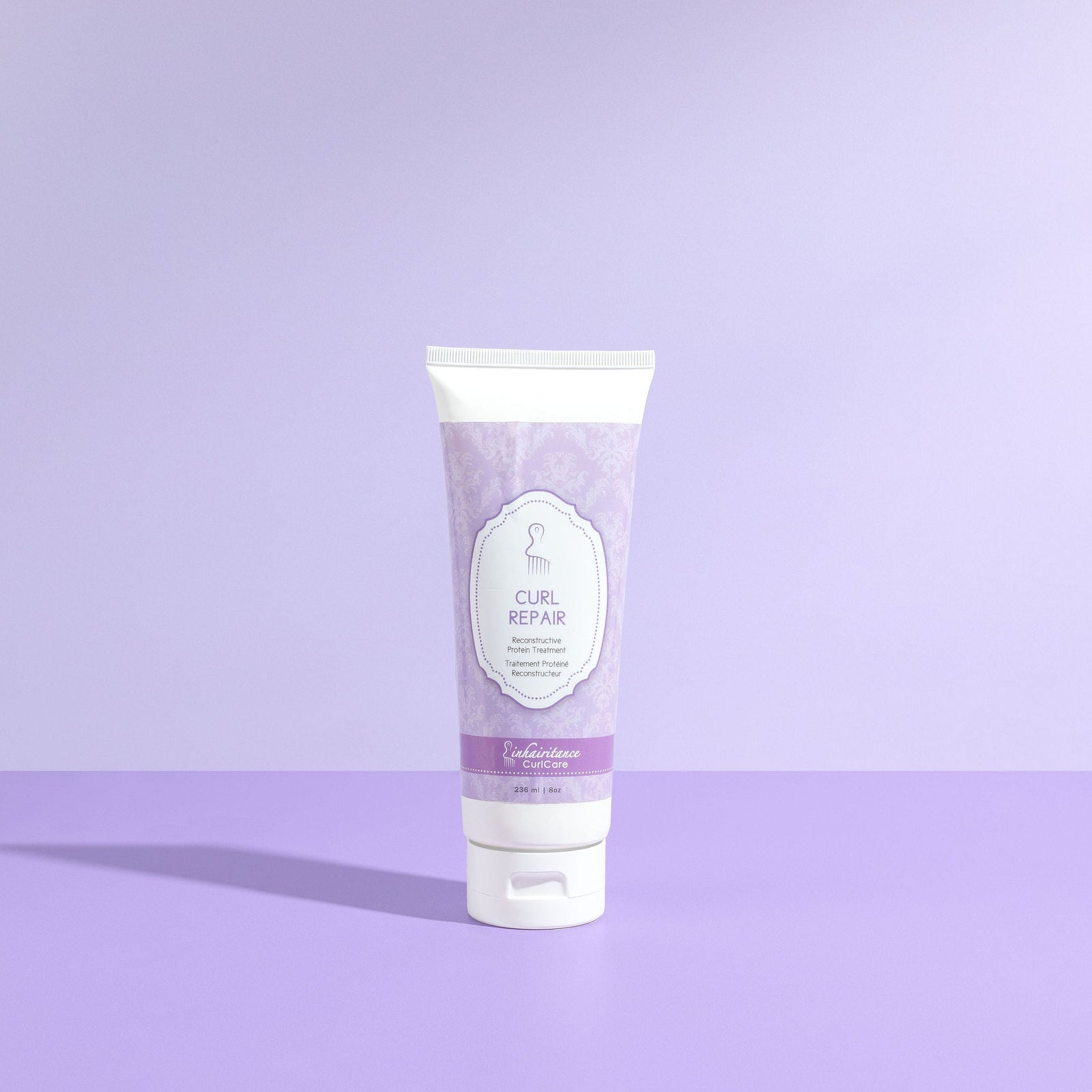
What the Summer Did to Your Curls — and How to Undo It
Sun, salt and chlorine don't just dry your hair out. They take apart the protein structure your strands are built from. Here's what's actually happening inside the strand, and why more conditioner has never once solved it.
You didn't do anything wrong this summer. You were outside. That's the whole point of summer.
But somewhere between the beach days and the pool afternoons, your hair started behaving differently. Ends feel rougher. Curls that used to spring back now stretch and stay stretched. You're using the same products you always have, possibly more of them, and your hair still feels thirsty an hour after wash day.
That combination — dry despite everything, with less bounce than it used to have — is not a hydration problem. It's a structural one.
What Sun and Water Actually Do
Your hair is mostly keratin, a protein arranged in long chains held together by chemical bonds. That structure is what gives a strand its strength and its elasticity — the ability to stretch under tension and return to its shape.
UV radiation degrades those bonds. Sustained sun exposure breaks down keratin and oxidizes the melanin that gives your hair its colour. That second part is why you came home with lighter pieces around your face. Those sun highlights were free and they looked good — but they were evidence of a chemical process happening throughout the strand, and it doesn't stop at the colour.
Salt water and chlorine pull moisture out and leave the cuticle raised. The cuticle is the shingled outer layer of the hair. When it lies flat, moisture stays where it belongs. Salt draws water out through osmosis; chlorine strips the natural oils that keep the cuticle sealed. Both leave it lifted and rough.
A raised cuticle is what high porosity means in practice. Water gets in fast and leaves just as fast. It's why your hair can drink an entire palmful of cream and feel dry again by afternoon — nothing is staying in.
Why More Conditioner Doesn't Fix It
Conditioner smooths the cuticle, adds slip and helps hair take on water. All good things — and none of them rebuild a protein structure that's been broken down. Once that structure is compromised, your hair simply can't retain the hydration you're giving it. You can keep adding more, and it keeps leaving.
Think of it like a wall with cracks running through it. You can keep repainting the surface, and it will look better for a while. But the cracks are still there, and the wall keeps failing in the same places. At some point you have to fill the cracks.
That's what a reconstructive protein treatment does. Hydrolyzed proteins are broken into fragments small enough to actually penetrate the hair shaft rather than sitting on top of it. Once inside, they bind to the damaged sites along the cortex and cuticle, temporarily filling the gaps and reinforcing the strand from within.
The result isn't cosmetic. Hair that's been properly reconstructed resists breakage, holds moisture longer, and gets its elasticity back — that spring you'd been missing.
What's Inside Curl Repair
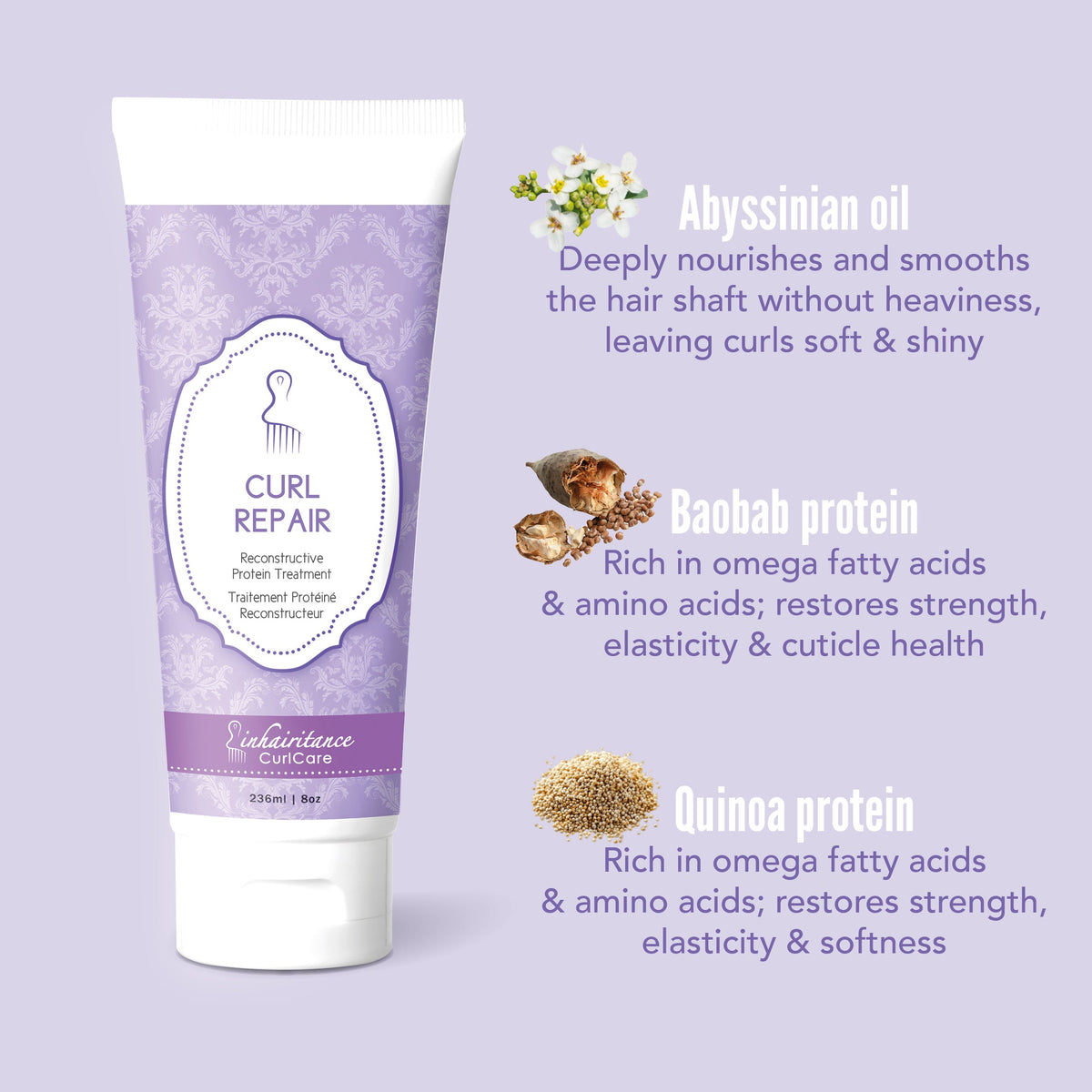
Hydrolyzed baobab protein
From the seed of the baobab tree. Rich in omega fatty acids and amino acids, it restores strength and elasticity while supporting cuticle health — the reason hair feels smoother rather than merely coated.
Hydrolyzed quinoa protein
Small enough to penetrate deeply, quinoa protein is a complete protein containing all nine essential amino acids. It reinforces the internal structure and improves softness at the same time, which is unusual — most strengthening ingredients trade softness away for strength.
Abyssinian oil
Pressed from Crambe abyssinica seed. It nourishes and smooths the hair shaft without weight, so the treatment leaves curls soft and shiny instead of stiff.
Rose of Jericho
The resurrection plant. Selaginella lepidophylla survives near-total dehydration in the desert and revives when it meets water again, and it brings that capacity to the formula — hydrating the inner layers of the hair shaft to renew elasticity and softness behind the protein work.
Curl Repair is vegan, like everything we make.
How to Use It
There are two protocols, and picking the right one matters more than most people realize. The difference isn't the product — it's whether you rinse it out.
Maintenance — for healthy hair
Every 4 to 6 weeks, it's time for a protein treatment — even when your hair is in good shape.
- Cleanse with Curl Renaissance, then Curl Renew Shampoo.
- Apply the treatment to sectioned hair, saturating thoroughly.
- Detangle each section and use your fingers to smooth and push the treatment into the hair shaft.
- Leave uncovered — do not use a plastic cap — and sit under a hooded dryer, or use a blow dryer, until curls are dry. About 20 to 30 minutes.
- Rinse thoroughly, then follow with your conditioner and your styling product.
Repair — for damaged, colour-treated or high-porosity hair
Every 2 to 3 weeks, while you're rebuilding.
- Cleanse with Curl Renew Shampoo.
- Apply the treatment to sectioned hair, saturating thoroughly.
- Detangle each section and use your fingers to smooth and push the treatment into the hair shaft.
- Leave the treatment in. Follow with your conditioner, styler and sealant on top.
- Dry completely under a hooded dryer or with a blow dryer, for maximum fusion of the proteins. This is what promotes healthy porosity, good elasticity and balanced pH.
Not sure which products follow it? Your Curl ID gives you the routine built for your porosity, diameter and curl type.
Curl tip
For stronger curls from root to tip, focus a little extra product on your ends. They're the oldest and most delicate part of your curls — they took the most sun, and they need the most rebuilding.
How Often, and for How Long
Protein repair isn't a single dramatic rescue. It's a cycle, and the cadence depends on how much damage you're working with.
Every 2 to 3 weeks for highly damaged, weak or high-porosity hair. Once a month, or every 6 weeks, for maintenance.
One bottle used on the repair schedule carries most people through a full rebuild — roughly the length of time it takes for a summer's worth of damage to stop announcing itself every wash day.
One caution worth naming: protein isn't a "more is better" ingredient. Overdoing it, especially on coarse strands, can tip hair from strong into stiff and brittle. Follow the cadence for your hair's actual condition rather than treating more frequently because it feels productive.
The Point Isn't Regret
Nobody should spend a summer avoiding the water to protect a hairstyle. You were meant to be in it.
September is just when the repair happens. Your ends did the work — this is the part where you give them something back.
Rebuild the structure. The moisture will finally stay.
Not sure what your hair needs? Take the Curl ID Quiz →Full ingredient list: Aqua/Water/Eau, Cetearyl Alcohol, Behentrimonium Chloride, Behentrimonium Methosulfate, Caprylic Capric Triglycerides, Hydrolyzed Quinoa, Hydrolyzed Adansonia Digitata Seed Extract, Crambe Abyssinica Seed Oil, Adansonia Digitata Seed Oil, Camellia Sinensis Leaf Extract, Panax Ginseng Root Extract, Selaginella Lepidophylla Extract, Cetyl Alcohol, Guar Hydroxypropyltrimonium Chloride, Caprylyl/Capryl Glucoside, Glycerin, Dehydroacetic Acid, Citric Acid, Butylene Glycol, Fragrance/Parfum.